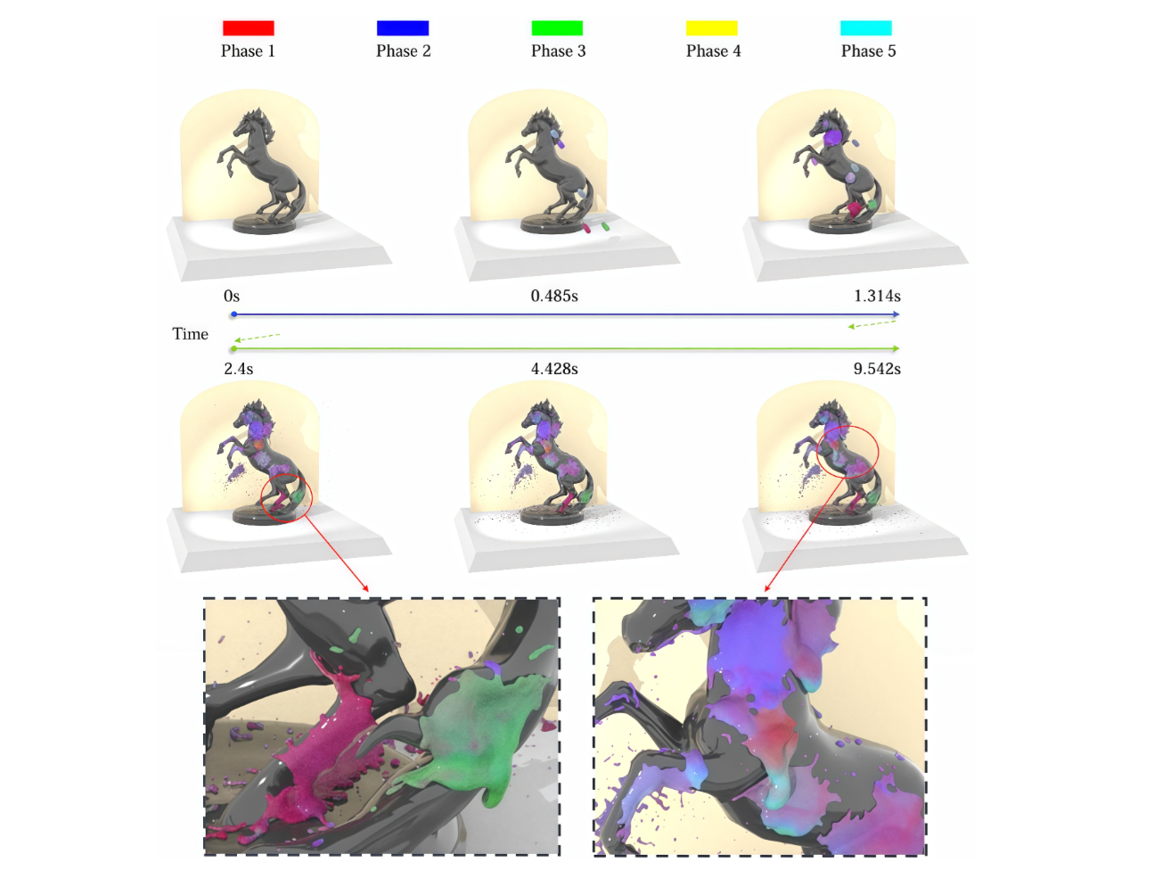
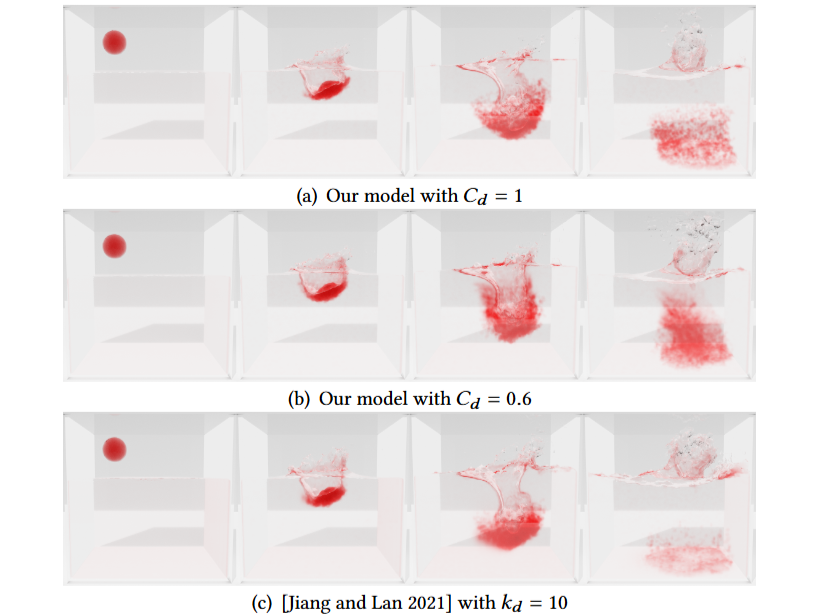
Fluid simulation is a central topic in computer graphics, encompassing a wide range of methodologies for modeling Newtonian, non-Newtonian, and viscoelastic behaviors across both single-phase and multiphase settings. Existing single-phase frameworks have achieved high visual fidelity, yet multiphase simulations remain limited in accurately capturing complex phase interactions, particularly under high-viscosity-ratio or viscoelastic conditions. To address these challenges, we develop a unified multiphase viscoelastic formulation capable of handling diverse fluid types—including Newtonian, shear-dependent non-Newtonian, and viscoelastic flows—within a single consistent framework. The formulation extends mixture-model approaches through a multimode conformation tensor representation, which enhances numerical stability via phase-level stress corrections and efficiently captures a broad spectrum of rheological behaviors. Compared with existing techniques, our framework achieves improved momentum–mass consistency and numerical stability, maintaining physically plausible results across wide viscosity ranges, advancing the state of the art in multiphase viscoelastic fluid simulation
@article{202603_ShenLong_Unified,title={A Unified Viscoelastic Solver for Multiphase Fluid Simulation Based on a Mixture Model},author={Shen, Long and Zhang, Yalan and Frey, Steffen and Telea, Alex and Kosinka, Jiří and Pan, Junjun and Wang, Xiaokun and Ban, Xiaojuan},journal={IEEE Transactions on Visualization and Computer Graphics},year={2026},month=mar,booktitle={},volume={32},number={7},pages={6085--6098},doi={10.1109/tvcg.2026.3677118},keywords={Physical Simulation; Multi-Mode Conformation Tensor; Mixture Model; Viscoelastic Fluids},publisher={},organization={},issn={},language={},day={},}
Multiphase Particle-Based Simulation of Poro-Elasto-Capillary Effects
Ruolan Li, Yanrui Xu, Yalan Zhang, Jiri Kosinka, Alexandru C. Telea, Jian Chang, Jian Jun Zhang, Xiaojuan Ban, and Xiaokun Wang
In Proceedings of the SIGGRAPH Asia 2025 Conference Papers, Dec 2025
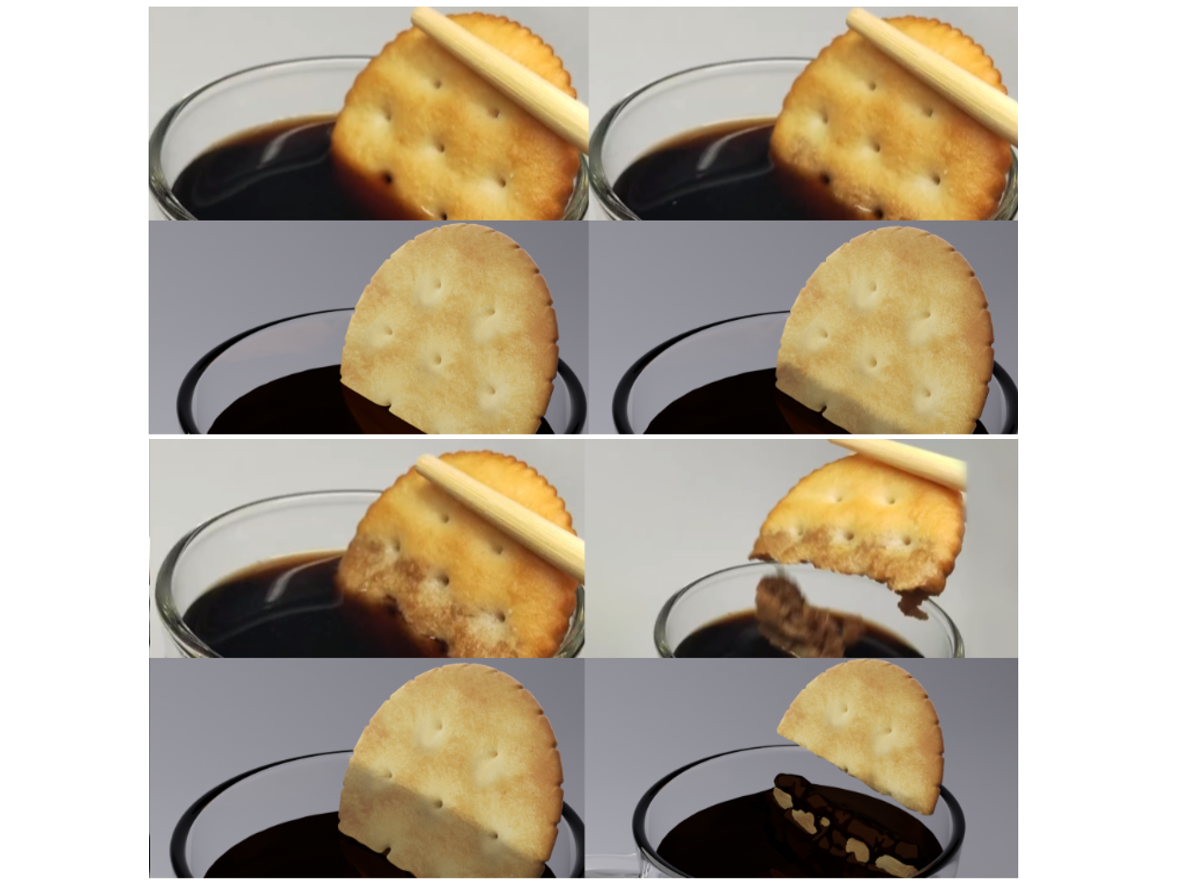
Simulating the interactions between fluids and porous media has attracted significant attention in computer graphics. A key challenge in this domain is modeling the Poro-Elasto-Capillary (PEC) coupling effect which describes the intricate interplay of three physical phenomena in soft porous materials: pore-structure evolution, elastic deformation, and wetting driven by capillary pressure. These phenomena collectively govern dynamic behavior such as the softening and fracturing of biscuits upon water absorption or the swelling of cellulose sponges due to liquid infiltration. Most existing simulation methods model porous media either as static grids or as solid particles with augmented water content attributes, failing to capture the full spectrum of PEC-driven effects due to the lack of physical modeling for elasticity, dynamic porosity changes, and capillary interactions. We propose a multiphase particle-based framework to holistically simulate PEC coupling effects with porous media. We develop a physics-driven model that captures elasticity and dynamic pore-structure evolution under capillary action, enabling realistic simulation of softening and swelling. We derive a saturation-aware pressure Poisson equation to enforce fluid incompressibility within and around the porous medium, ensuring accurate capillary-driven flow while preserving mass and momentum. Finally, we propose a representative elementary volume-based formulation to unify the modeling of homogeneous macro-porous media and cavity-embedded structures, enhancing the representation of pore-scale PEC effects. Comparisons with prior work and real footage show the advantages of our approach in achieving visually realistic fluid-porous media interactions
@inproceedings{202512_LiRuolan_Multiphase,title={Multiphase Particle-Based Simulation of Poro-Elasto-Capillary Effects},author={Li, Ruolan and Xu, Yanrui and Zhang, Yalan and Kosinka, Jiri and Telea, Alexandru C. and Chang, Jian and Zhang, Jian Jun and Ban, Xiaojuan and Wang, Xiaokun},journal={},year={2025},month=dec,booktitle={Proceedings of the SIGGRAPH Asia 2025 Conference Papers},volume={},number={},pages={1--11},doi={10.1145/3757377.3763960},url={https://dl.acm.org/doi/full/10.1145/3757377.3763960},keywords={Physically-Based Animation; Capillarity; Multiphase Flow; Porous Media; Incompressible Fluid},publisher={Association for Computing Machinery},organization={},issn={},language={},day={},}
Dynamic Importance Monte Carlo SPH Vortical Flows with Lagrangian Samples
Xingyu Ye, Xiaokun Wang, Yanrui Xu, Alexandru C. Telea, Jiří Kosinka, Lihua You, Jian Jun Zhang, and Jian Chang
IEEE Transactions on Visualization and Computer Graphics, Sep 2025
Fluid SimulationImportance Monte CarloSPHVortical Flow
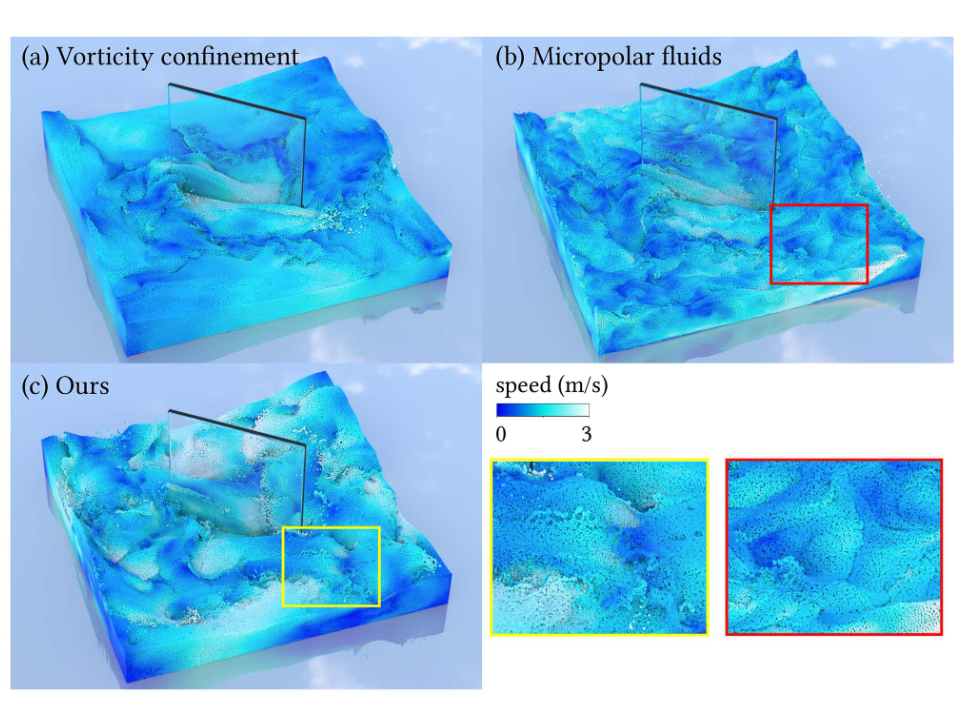
We present a Lagrangian dynamic importance Monte Carlo method without non-trivial random walks for solving the Velocity-Vorticity Poisson Equation (VVPE) in Smoothed Particle Hydrodynamics (SPH) for vortical flows. Key to our approach is the use of the Kinematic Vorticity Number (KVN) to detect vortex cores and to compute the KVN-based importance of each particle when solving the VVPE. We use Adaptive Kernel Density Estimation (AKDE) to extract a probability density distribution from the KVN for the the Monte Carlo calculations. Even though the distribution of the KVN can be non-trivial, AKDE yields a smooth and normalized result which we dynamically update at each time step. As we sample actual particles directly, the Lagrangian attributes of particle samples ensure that the continuously evolved KVN-based importance, modeled by the probability density distribution extracted from the KVN by AKDE, can be closely followed. Our approach enables effective vortical flow simulations with significantly reduced computational overhead and comparable quality to the classic Biot-Savart law that in contrast requires expensive global particle querying
@article{202509_YeXingyu_Dynamic,title={Dynamic Importance Monte Carlo SPH Vortical Flows with Lagrangian Samples},author={Ye, Xingyu and Wang, Xiaokun and Xu, Yanrui and Telea, Alexandru C. and Kosinka, Jiří and You, Lihua and Zhang, Jian Jun and Chang, Jian},journal={IEEE Transactions on Visualization and Computer Graphics},year={2025},month=sep,booktitle={},volume={31},number={12},pages={10652--10666},doi={10.1109/tvcg.2025.3612190},keywords={Fluid Simulation; Importance Monte Carlo; SPH; Vortical Flow},publisher={},organization={},issn={},language={},day={},}
Editable Mesh Animations Modeling Based on Controlable Particles for Real-Time XR
Xiangyang Zhou, Yanrui Xu, Chao Yao, Xiaokun Wang, and Xiaojuan Ban
IEEE Transactions on Visualization and Computer Graphics, Mar 2025
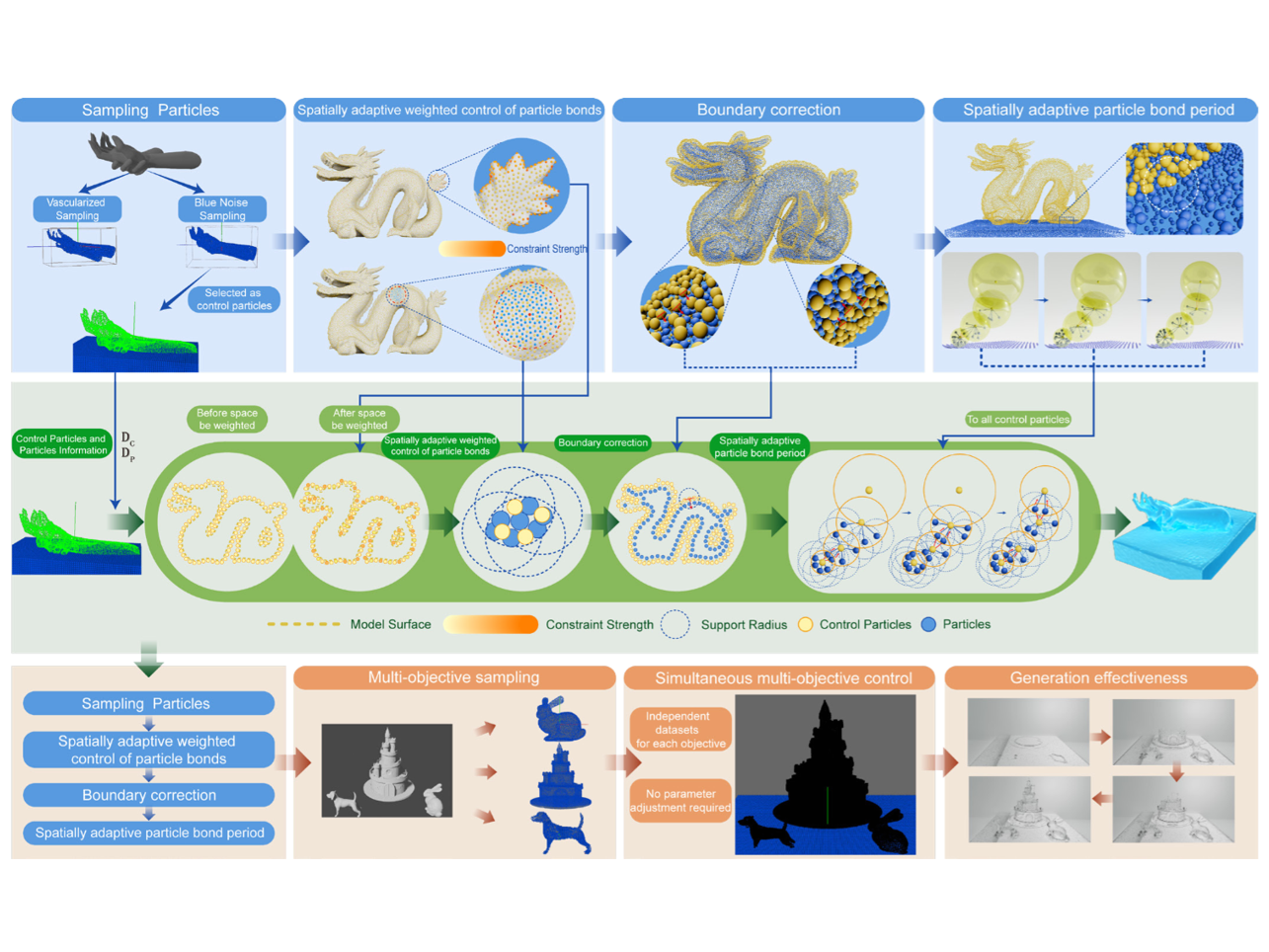
The real-time generation of editable mesh animations in XR applications has been a focal point of research in the XR field. However, easily controlling the generated editable meshes remains a significant challenge. Existing methods often suffer from slow generation speeds and suboptimal results, failing to accurately simulate target objects’ complex details and shapes, which does not meet user expectations. Additionally, the final generated meshes typically require manual user adjustments, and it is difficult to generate multiple target models simultaneously. To overcome these limitations, a universal control scheme for particles based on the sampling features of the target is proposed. It introduces a spatially adaptive control algorithm for particle coupling by adjusting the magnitude of control forces based on the spatial features of model sampling, thereby eliminating the need for parameter dependency and enabling the control of multiple types of models within the same scene. We further introduce boundary correction techniques to improve the precision in generating target shapes while reducing particle splashing. Moreover, a distance-adaptive particle fragmentation mechanism prevents unnecessary particle accumulation. Experimental results demonstrate that the method has better performance in controlling complex structures and generating multiple targets at the same time compared to existing methods. It enhances control accuracy for complex structures and targets under the condition of sparse model sampling. It also consistently delivers outstanding results while maintaining high stability and efficiency. Ultimately, we were able to create a set of smooth editable meshes and developed a solution for integrating this algorithm into VR and AR animation applications
@article{202503_ZhouXiangyang_Editable,title={Editable Mesh Animations Modeling Based on Controlable Particles for Real-Time XR},author={Zhou, Xiangyang and Xu, Yanrui and Yao, Chao and Wang, Xiaokun and Ban, Xiaojuan},journal={IEEE Transactions on Visualization and Computer Graphics},year={2025},month=mar,booktitle={},volume={31},number={5},pages={3365--3375},doi={10.1109/tvcg.2025.3549573},keywords={Particle Systems; Control Particles; Virtual Environments; Augmented Reality Application},publisher={},organization={},issn={},language={},day={},}
An Implicitly Stable Mixture Model for Dynamic Multi-Fluid Simulations
Yanrui Xu, Xiaokun Wang, Jiamin Wang, Chongming Song, Tiancheng Wang, Yalan Zhang, Jian Chang, Jian Jun Zhang, Jiri Kosinka, Alexandru Telea, and Xiaojuan Ban
Particle-based simulations have become increasingly popular in real-time applications due to their efficiency and adaptability, especially for generating highly dynamic fluid effects. However, the swift and stable simulation of interactions among distinct fluids continues to pose challenges for current mixture model techniques. When using a single-mixture flow field to represent all fluid phases, numerical discontinuities in phase fields can result in significant losses of dynamic effects and unstable conservation of mass and momentum. To tackle these issues, we present an advanced implicit mixture model for smoothed particle hydrodynamics. Instead of relying on an explicit mixture field for all dynamic computations and phase transfers between particles, our approach calculates phase momentum sources from the mixture model to derive explicit and continuous velocity phase fields. We then implicitly obtain the mixture field using a phase-mixture momentum-mapping mechanism that ensures conservation of incompressibility, mass, and momentum. In addition, we propose a mixture viscosity model and establish viscous effects between the mixture and individual fluid phases to avoid instability under extreme inertia conditions. Through a series of experiments, we show that, compared to existing mixture models, our method effectively improves dynamic effects while reducing critical instability factors. This makes our approach especially well-suited for long-duration, efficiency-oriented virtual reality scenarios
@inproceedings{202312_XuYanrui_Implicitly,title={An Implicitly Stable Mixture Model for Dynamic Multi-Fluid Simulations},author={Xu, Yanrui and Wang, Xiaokun and Wang, Jiamin and Song, Chongming and Wang, Tiancheng and Zhang, Yalan and Chang, Jian and Zhang, Jian Jun and Kosinka, Jiri and Telea, Alexandru and Ban, Xiaojuan},journal={},year={2023},month=dec,booktitle={SIGGRAPH Asia 2023 Conference Papers},volume={},number={},pages={1--11},doi={10.1145/3610548.3618215},url={https://dl.acm.org/doi/abs/10.1145/3610548.3618215},keywords={Fluid Simulation; Mixture Models; Incompressible Fluids},publisher={},organization={},issn={},language={},day={},}
Contact
For research collaboration, academic exchange, and project enquiries, please email wangxiaokun@ustb.edu.cn.